Real Deal Fundraising
  • Home
  • Blog
  • Subscribe
  • Products

Rethinking Board Recruitment: The 4 Ws That Really Matter

7/20/2025

0 Comments

 
Picture

Rethinking Board Recruitment: The 4 Ws That Really Matter

When I ask a nonprofit leader what they’re looking for in a new board member, I often hear one of three things:
​
“We need someone with deep pockets.”
“We need someone who knows people.”
“We just need someone who will actually show up and help.”

That’s where the old 3 Ws model comes from: Wealth, Window Dressing, and Worker Bee.

(Quick note: I didn’t come up with those labels – and they’re not meant to be demeaning. These short-hand categories have been floating around the nonprofit world for decades because they’re easy to remember and speak to the roles board members often play.)

But that “Worker Bee” bucket? It was doing too much. There’s a big difference between someone who’s eager to help and someone who brings a specific, strategic skill set that your organization really needs.
So I’ve updated the model. Here’s what I use now:

The 4 Ws of Board Value

1. Wealth
Financial capacity and willingness to give meaningfully. These board members lead with their giving and help bring others to the table.

2. Window Dressing
These members come with name recognition, public credibility, or powerful networks. And let’s be clear: this isn’t fluff. Think of actual window dressing – it draws people in. Visibility, reputation, and access to new audiences can absolutely drive momentum, when paired with authentic engagement.

3. Willing Hands
These are the doers. They show up, roll up their sleeves, make thank-you calls, stuff envelopes, and volunteer at events. Their time and energy are often the engine behind day-to-day progress.

4. Wisdom
These folks bring specific expertise – finance, legal, marketing, investments, HR, governance, DEI. They help your organization make informed, strategic decisions.

A Visual Way to Think About It

​You can picture this concept as a four-part Venn diagram – each W intersecting with the others. The center is where your dream board prospects live: those rare folks who bring all four.
Picture
Note: This image is a helpful visual, but not mathematically perfect. Some combinations (like Wealth + Wisdom) don’t appear distinctly due to the limitations of 4-part diagrams.

A Practical Way to Use It

In real-world board recruitment, it can help to ditch the diagram and move to a simple grid.

A spreadsheet like the one below makes it easier to evaluate prospective members based on the categories they fulfill – and shows where you’re strong or where you need to recruit intentionally.
​​
Each person is evaluated on whether they bring one, two, three, or all four of the Ws. Then you can sort, filter, and prioritize your outreach.
Picture

The Real Goal

Build a board full of people who bring at least two of these categories – and who align with your mission and values. Look for overlaps. The magic is in the mix.

And don’t leave this work to the board alone.

Your fundraising staff and executive leadership need to be working hand-in-hand with the nominating committee – from the very beginning. They know the needs, they understand the gaps, and they’ll be the ones partnering with these new board members down the road.

When you use the 4 Ws to guide your recruitment, you’re not just filling seats. You’re building something durable, strategic, and deeply aligned with your mission.

P.S. Want to take the first step?
Grab my free Board Fundraising Menu –  a customizable and printable tool that helps your board members choose where and how they can plug into fundraising. It’s clear, easy, and surprisingly motivating.
DOWNLOAD THE FREE MENU
Cheers!
Picture
PS - I hope you’ll continue the conversation by subscribing to Real Deal Fundraising. When you subscribe, you’ll get my e-newsletter, which includes the best articles on fundraising, productivity, and cool stuff every week. The whole thing is curated awesomeness as well as freebies like webinars, instructional videos, and whatever else I can put together to be helpful to you!
SUBSCRIBE
If you liked this…
  • Why Most Fundraising Plans Fail
  • The Magic Formula for Making a Confident Fundraising Ask
  • Your Board Wants to Help with Fundraising – They Just Don’t Know How
  • Discovery Visits Demystified
  • What to Say to Donors in Uncertain Times
0 Comments

Your Board Wants to Help with Fundraising – They Just Don’t Know How

6/22/2025

0 Comments

 
Picture

Your Board Wants to Help with Fundraising – They Just Don’t Know How

Let’s bust a myth right now: “Our board won’t help with fundraising.”
That’s almost never the full truth.
Most board members want to help. They believe in your mission. They want your organization to succeed. What they don’t have is clarity or support.
They don’t know what to do, where to start, or how to help in a way that feels comfortable and meaningful.
​In other words: this is usually a training problem, not a motivation problem.

If you want board members to engage with fundraising, you have to give them a roadmap.

That’s why I created a “Board Fundraising Menu” – an easy, low-pressure way to show board members that fundraising is more than just asking for money. (Full transparency: this is an idea inspired by Andy Robinson, who has great books about how to train your board to raise money.) It’s about helping create the conditions where giving is more likely.

I used this with a higher education Board of Trustees and told them it was an “All You Can Eat” menu but they had to pick at least one from each category: Appetizers, Entrees, and Desserts. I walked them through filling it out in the meeting and left with a list of folks who could write notes, open doors, make calls, and host events!

​Here are 3 specific actions your board members could take today:

Appetizer: Sign and personalize donor letterS

If picking up the phone makes them queasy, that’s fine. Start here.

A short handwritten note or a personally signed appeal letter makes a huge difference – and helps board members feel included without the pressure of a direct ask.

Entrée: Host a house party or donor touR

This one’s for your connectors.
​
Board members don’t have to ask for money – they just need to open the door. Hosting a gathering where staff shares impact stories or tours a program site is a powerful way to build trust and widen your prospect funnel.

Dessert: Make thank-you calls to donorS

No one is ever mad about a thank-you call.
​
And hearing directly from a board member? That’s memorable. It boosts donor retention (especially for first time donors) and builds board confidence in your development process.

But here’s the truth: board members need support.

Okay, okay – you’re busy. I know. You’re running events, managing emails, answering the auditor’s questions, and cleaning up after the copier jammed again.

But they’re busy too. They’re volunteers. They have full-time jobs, families, responsibilities – and most of them have never done this before. Anyone would feel unsure operating outside their expertise.

So when a board member says, “I’ll introduce you to my friend,” the best thing you can do is write a draft email for them to send.

Not because they can’t write one, but because it saves them time and anxiety. It gives them something to react to. They can edit it to sound like themselves – but only they can send it.

If they offer to make calls, set them up for success with a guide that explains the data set, answers frequently asked questions, and provides scripts and samples. And don’t forget to give them a seamless way to get all that feedback to you so it can be recorded in your database too!

Your role? Be their concierge. Their guide. Their teacher.
​

When you hold their hand through these steps, you're not just getting results today – you’re building better, more confident board members for the future.

The secret? Board members are your partners.

If this kind of clarity and confidence sounds like something your board needs, I’ve built something for you. Tired of chasing your board or getting ghosted after a meeting? Inside the Smart Start Fundraising System, you’ll get a plug-and-play plan to turn passive board members into proactive partners.
​
Because fundraising isn’t a solo sport. It’s a team effort. And your board? They're not just fiduciaries – they’re your fundraising partners. But they need the tools, training, and support to step into that role effectively.

Want the full board engagement menu?

It’s included in the Smart Start Fundraising System – along with a plan to actually activate it.

💡 You’ll learn how to:
  • Train your board without making them panic
  • Assign roles that align with their personalities and strengths
  • Make board fundraising support sustainable, not sporadic

🎯 Enrollment is open now.
Click below to get started and download the full board fundraising menu inside:

👉 [Click here to enroll now]

Because “they won’t help” can become “they’re amazing ambassadors” – with the right structure in place.

Cheers!
Picture
​PS - I hope you’ll continue the conversation by subscribing to Real Deal Fundraising. When you subscribe, you’ll get my e-newsletter, which includes the best articles on fundraising, productivity, and cool stuff every week. The whole thing is curated awesomeness as well as freebies like webinars, instructional videos, and whatever else I can put together to be helpful to you!
SUBSCRIBE
If you liked this…
  • Why Most Fundraising Plans Fail (and How to Build One That Doesn’t)
  • How to Build a Philanthropy Calendar That Drives Digital Donations
  • Why Nonprofits Can’t Afford to Sleep on IRA Rollovers
  • 4 Power Questions to Ask Donors That Build Rapport and Lead to Major Gifts
  • Culture of Philanthropy Check-Up
0 Comments

6 Ways to Show DONORS Gratitude in the New Year

12/7/2024

0 Comments

 
Picture

6 Ways to Show Donors Gratitude in the New Year

As we turn the page to a new year, it’s the perfect time to reflect on the incredible impact your donors have made on your organization. Donor appreciation isn't just about wrapping up last year's success - it’s about laying the groundwork for lasting relationships that will sustain your mission well into 2025 and beyond.
​
In nonprofit fundraising, donor retention is key. It’s much easier (and more cost-effective) to retain a donor than to acquire a new one, which is why a thoughtful approach to showing gratitude can be a game-changer. Starting the new year on a note of appreciation can make all the difference in keeping those relationships strong. Here are six creative and practical ways to show your gratitude this New Year:

1. New Year’s Cards

Instead of sending out traditional holiday cards, why not opt for a New Year’s card? It’s a great way to stand out, especially since January mail isn’t competing with the December rush. At my current institution, where we serve a multi-religious community, we steer clear of specific religious holiday cards, but New Year’s cards offer a respectful and inclusive option.

This isn’t just about sending a card; it’s about showing donors they’re valued as you enter a fresh chapter. By sending a message of gratitude and well wishes for the year ahead, you remind them that their support is crucial to your mission’s success.

Why It Works: A New Year’s card avoids the crowded December mailbox, acknowledges diverse traditions, and sets a positive tone for the year ahead.

Read More
0 Comments

What to Say to Donors in Uncertain Times: The Near, Dear, Clear Fundraising Framework

3/26/2020

1 Comment

 
Picture

What to Say to Donors in Uncertain Times: The Near, Dear, Clear Fundraising Framework (updated May 2025)


We are all scrambling. ​

If you’ve found yourself rewriting the same appeal three times -- or wondering if it’s even okay to make an ask right now -- you’re not alone. In a year marked by economic uncertainty, political tension, and donor hesitation, fundraisers are feeling the weight of every word.

The solution isn’t silence. It’s clarity. And that’s where Near, Dear, and Clear comes in.

How can we keep our donors connected to our organizations in this unstable environment?

Back in 2020, when it became clear that I would not be allowed to travel anymore for work, I fell back on a maxim I heard somewhere early in my fundraising career. It rhymes so that’s convenient and an aid to memory.

Near
Dear
Clear


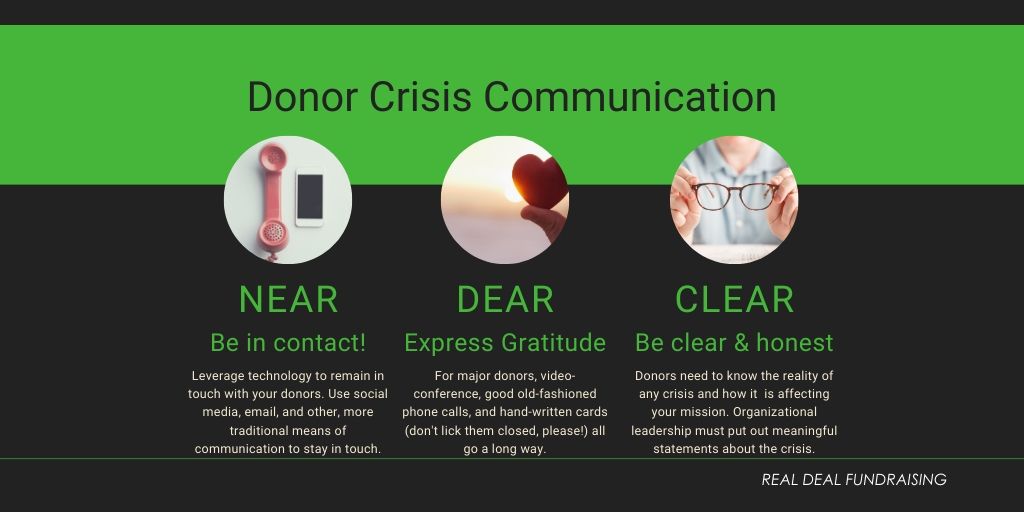
In any circumstances where rapid change is taking place, we must take great pains to keep our donors near, dear, and clear. What does that mean as a guide to practical action?

Let’s take each part of the maxim in turn:

Near: Be in Contact & Stay Close

You will need to leverage all forms of media at various levels to keep in touch with your donors.

First, for your major donors, set up as many one-on-one Zoom meetings as you can reasonably handle each week to check in with them. Take it week-by-week so it will not be overwhelming but striving for 6-8 substantial phone calls or Zoom meetings with major donors per fundraiser seems appropriate.

Secondly, utilize digital means of connection as much as possible. Send email or text updates to your constituents. Don’t bombard them with info but if you have meaningful information to report, do so on all available channels. If you have Facebook groups, use those to communicate too. Encourage your supporters to share info so it gets in more newsfeeds and inboxes.

Third, for your mid-level donors or major donors that you cannot check in with immediately, don’t forget about good old mail and phone. You can do a quick check-in calling campaign one day per week and write some hand-written notes.

What to say: 
  • "You're part of this work, and we’re grateful you’ve stayed with us.”
  • “We thought of you when we saw this update: because your gift made it possible.”

Dear: Express Gratitude & Lead with Values

Your messaging needs to let donors know that you care about them as people. It’s not just about expressing our usual level of stewardship and gratitude. This is thanking them for believing enough in your organization’s mission to hang in there in this time of great change and uncertainty.

​Express gratitude not only as a staff member but express gratitude on behalf of those your organization serves. Let them know that because of them, your mission continues and will continue after this crisis.

What to say:
  • “This mission isn’t just close to our hearts; it’s at the center of our community’s future.”
  • “We believe generosity is a force for good, especially when things feel uncertain.”

Clear: Make the Ask Simple

Make sure your organization is crystal clear on its priorities. The first of which should be the health, safety, and welfare of those they serve. Repeat this often to your constituents.

However, do not shy away from honestly telling donors how this crisis is affecting your organizational needs and its finances. Your major donors and board members especially deserve the candid talk about what is needed, what might be needed, and why.

What to say:
  • “A gift of $50 helps cover a week of meals for a student in crisis.”
  • “Will you make a gift today to help us stay steady and serve boldly in 2025?”

Did you find the framework of near, dear and clear helpful in thinking about how you are keeping donors connected these days? What other strategies have you tried in the last couple of weeks that keep donors near, dear, and clear? Tell me below in the comments!

Again, I hope this was helpful to you. If it was, please leave me a comment below.

Take care and be well,

Jessica ​
Picture
PS - I hope you’ll continue the conversation by subscribing to Real Deal Fundraising. When you subscribe, you’ll get my e-newsletter, which includes the best articles on fundraising, productivity, and cool stuff every week. The whole thing is curated awesomeness as well as freebies like webinars, instructional videos, and whatever else I can put together to be helpful to you!
Subscribe
PPS - Want more messaging tools that build trust and drive giving - without gimmicks? Inside my Smart Start Fundraising System course, we unpack the words, frameworks, and mindset shifts that actually move donors to action. [→ Get on the list here.] Course launches 06.03.25!
Picture

If you liked this… ​

  • Who’s Afraid of Fundraiser Burnout (and Turnover)? You Should Be
  • Beautiful on a Budget: How to Design Stunning Fundraising Event Decor for $250 or Less
  • The Problem with Totes and T-Shirts: Why Freebies Can Undermine Fundraising
  • 4 Power Questions to Ask Donors That Build Rapport and Lead to Major Gifts
  • My Favorite Apps for Work Travel
1 Comment

The Main Thing . . . My Fundraising Mantra

5/2/2017

 
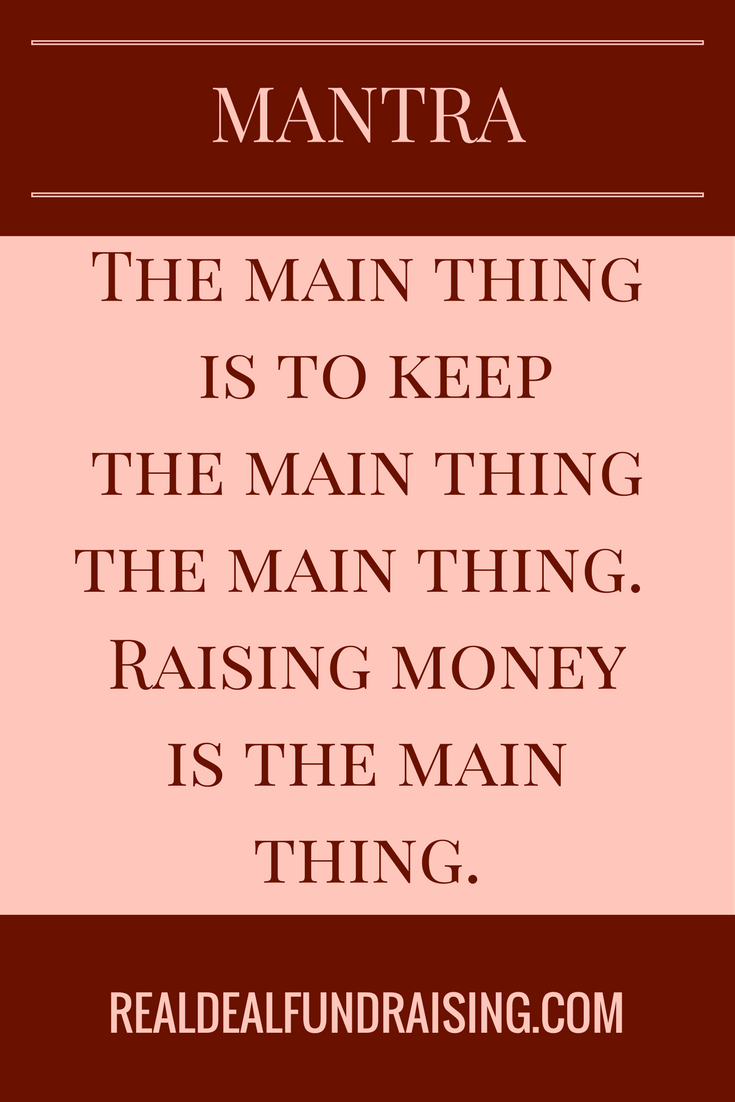
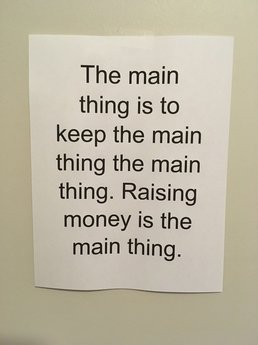
This sign hung in my various offices for over a decade.
Picture
I guess you could consider this a motivational poster of sorts, but I think it was actually a very early meme. These two sentences have become my fundraising mantra. Something I repeat to keep myself focused and to cope when things get rough.

Because I’m both a nerd and a yogi, I looked up “mantra” in the Oxford English Dictionary. The term “mantra” comes from Sanskrit and the root words mean basically: "thought support" or device to support thought and action. This is exactly what this simple sign has been for me throughout my career. Even the repetitive rhythm of it helps in its function as thought support.

The main thing is to keep the main thing the main thing. Raising money is the main thing.

Let me tell you the story of this mantra:

To give credit where it is due, the original sign was created for me by Mark Nelson, who was the Treasurer for the Libertarian National Committee (the Libertarian Party) in 2004-2005. So, he was a board officer for the organization I was working for at the time.

I was the only full-time fundraiser for the national organization and I was only 23 years old.

Their theory was to hire smart young people who would be “cheaper” salary-wise for the DC area. The exchange was that I would get a ton of valuable training and experience and they would get energetic labor.

However, I was overwhelmed and I think Mark sensed it. I was managing a conversion from an antiquated custom donor database to Raiser’s Edge. I was producing a monthly newsletter for our recurring donors. I was helping to plan the national convention and scouting locations for the next convention. I was recruiting and training paid callers to renew memberships via phone and managing our intern program. With the help of a consultant, I was managing monthly direct mail campaigns and planning fundraising events. Then, because the LP was a political organization, staff frequently got pulled into controversies and political discussions. 

I’m tired and anxious just typing about everything I was called to do.

As treasurer of course, Mark had a keen interest in keeping me motivated. On a trip to our DC office, he walked in and taped the sign to the wall above my computer monitor and explained what it meant.

The “main thing” meme helped me to prioritize my work and keep my head on straight. It also reminded me that the officers of the organization supported me in my main role.

My job as a fundraiser is revenue generation. Everything else must fade in comparison.

When I left the LP, I took this simple sheet of copy paper with me and posted it in my new office at the University of South Carolina. This concept continued to keep me focused as I was hiring 110 student callers per semester to raise $1.47 million via phone annually.

When I took a job as behind-the-scenes project manager with RuffaloCODY (now Ruffalo Noel Levitz), I would see the sign and feel sad. I knew then that I missed frontline fundraising. I missed chasing down a dollar goal. It helped me navigate my career back to raising money.

At some point in changing offices, the original paper got ragged and I disposed of it. But, when I was at Southern Miss and we tripled our annual fund income in one year, I recreated the poster for some of our gift processors who were overwhelmed and wanted a reminder of how their work connected to the big picture. It became a bit of an office-wide mantra.

Now that I’m back at a small shop, I think of this mantra often. I try hard to “stay in my lane” and keep the focus on fundraising. There is much to do, the need is great, and it is easy to feel like you are never doing quite enough.

But, the main thing . . . is to keep . . . the main thing . . . the main thing.

And, raising money . . . is the main thing.

At any organization, you will be asked to do many mundane things (I collectively call them TPS reports). These include: expense reports, submission forms, demographic changes in database, meetings, etc. Do these things, but strive to automate those tasks as much as you can so that they don’t distract you from the main thing: raising money.

At some organizations, especially those that are not organizationally mature, fundraisers will get pulled into political discussions and controversies. Continue to come back to mission and how the main thing (fundraising) supports that mission. When people around you go low, you go high. Keeping focused on raising money is the high road.

The main thing is to keep the main thing the main thing. Raising money is the main thing.

What’s your fundraising mantra? How do you keep yourself focused?

Comments and questions are, as always, welcomed and encouraged!

Cheers,

Jessica Cloud

PS – If you liked this post, you might also like these:
  • In praise of being deep in the job chaos
  • Where’s the joy in your fundraising plan?
  • Fundraising is an amazing career choice
  • Applying to be a CFRE
  • The CFRE Exam
 
 PPS - If you found this article helpful, please comment and let me know. Also subscribe to Real Deal Fundraising so you don't miss a post! You'll get my guide to Call Center Games for Free!​​
Subscribe
Picture

​Culture of Philanthropy Check-Up

4/18/2017

 
Picture
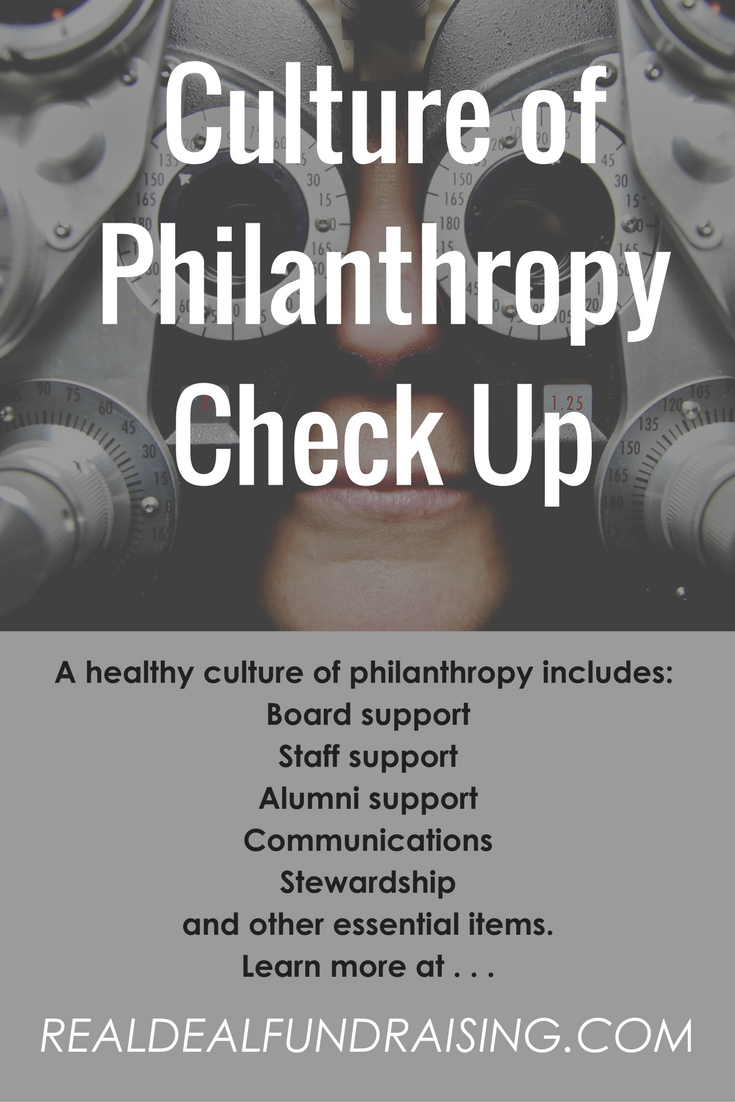
Building and maintaining a culture of philanthropy is hard work. It is deep work that takes years to build and moments to destroy. But having a healthy culture of philanthropy makes work more fun and makes fundraising easier. It’s worth having a periodic check-up to assess how your institution is doing.

Answer these questions for your institution:

Board Support
  • Does your board of directors (or board of trustees) support the organization as current year donors at 100% participation?
  • Board support is a sign of stakeholder investment. It also shows that your closest advocates are current with their support. The level of the support doesn't matter so much as the consistency and recency of that support. PS - It's easier to ask for others to give if you are a current donor.

Staff Support
  • Does your fundraising staff support the organization as current year donors at 100% participation?
  • Does at least 50% of your organization’s overall staff (and faculty) support the organization as current year donors?
  • Again, staff support is a measurement of stakeholder investment. Does your staff (especially your fundraising staff, believe in the mission enough to back it with their personal funds? The level doesn't mean as much as the participation.

Alumni support (or Grateful Patient support)
  • This category assesses whether those served by your organization’s mission give back to the organization later. This is a sign of institutional effectiveness.
  • What is your alumni (or similar) participation rate? You’ll know whether this is good for your organization or not. The level at which this metric is outstanding varies widely from institution to institution.

Fun Factor
  • Does your organization frequently have concrete signs that fundraising is seen as an enjoyable community endeavor? (For example, an annual gala, a stewardship picnic, a “Dancing with the Deans” competition, etc.)
  • List what you currently do to put the “fun” in fundraising.
  • Write down three new ideas to improve your fun factor.

Communications
  • How often do your constituents hear from the organization without a fundraising pitch?
  • Do these communications include stories of impact?
  • Are you communicating in different media? Email, print, video, etc?

Stewardship and Donor Relations
  • Do you have meaningful giving societies?
  • Do you have a person designated to assist donors with any “customer service” type issues? 
  • How is your data management and data integrity? Nothing kills a philanthropic feeling like your name being wrong on an invitation.
  • Stewardship is not just the purview of the staff member with "donor relations" in his or her title. It is an office-wide perspective of service and connection. From your front desk associates to student workers/interns to your accountants on staff to gift officers and especially advancement services and gift processing staff, improving donor relations should be everyone's primary objective.

Other questions to think about:
  • Does your organization show the impact of giving clearly and broadly?
  • For major donors, do you create unique reports and experiences that connect for them their gift to the impact in the world?
  • Do you see expressions of gratitude at all levels of the organization? Where could your organization do better?
  • Are the needs of the institution are clearly expressed for donors of all levels using different media?
  • Does the institution set expectations for giving through specific asks, giving society thresholds and endowment minimums?
  • Are fundraising goals embraced by both fundraising staff and program staff/faculty?

How did you feel about the assessment? Where are you doing well? Where should you improve? 

As always, comments and questions are welcome and encouraged!

Cheers,

Jessica

PS - If you liked this post, you might also like these: 
  • Goals versus projections
  • What should a strategic plan contain?
  • Planning for the Unexpected
  • Conducting a Benchmarking Study
  • My Exhaustive Event Planning Checklist

PPS - If you found this article helpful, please comment and let me know. Also subscribe to Real Deal Fundraising so you don't miss a post! You'll get my  guide to Call Center Games for Free!​​
Subscribe
Picture
    Picture

    Jessica Cloud, CFRE

    I've been called the Tasmanian Devil of fundraising and I'm here to talk shop with you. 

    Subscribe

    Archives

    October 2025
    September 2025
    August 2025
    July 2025
    June 2025
    May 2025
    April 2025
    March 2025
    February 2025
    January 2025
    December 2024
    October 2024
    September 2024
    August 2024
    July 2024
    June 2024
    July 2020
    June 2020
    May 2020
    April 2020
    March 2020
    September 2017
    August 2017
    May 2017
    April 2017
    March 2017
    February 2017
    November 2016
    October 2016
    September 2016
    August 2016
    July 2016
    June 2016

    Categories

    All
    Advancement Services
    Alumni Relations
    Annual Giving
    Apps
    Asking
    Board Relations
    Books
    Branding
    Budget
    Caller Training
    Career
    Case Building
    CFRE
    Communications
    Contact Rates Series
    Covid19
    Crisis Response
    Dance
    Data Integrity
    Data Research
    Development
    Digital Fundraising
    Direct Mail
    Donor Events
    Donor Relations
    E Books
    E-books
    Email
    Fiscal Year End
    Flash Mob
    Free Resources
    Fundraising
    FUNdraising Friday
    Geekery
    Giving Days
    Giving Societies
    Giving Tuesday
    Graphic Design
    Impact
    In Depth
    In-depth
    Interview
    Irarollovers
    Lobby
    Love Your Career
    Major Gifts
    Management
    Motivation Mondays
    Nonprofit Leadership
    Online
    Phonathon
    Planned Giving
    Productivity
    Public Speaking
    Quizzes
    Recurring Gifts
    Self Care
    Social Media
    Stewardship
    Strategic Planning
    Student Debt
    Team Building
    TED Talks
    Telefund
    Thoughts For Thursday
    Thoughts-for-thursday
    Travel Hacks
    Travel-hacks
    Trip Planning
    Tuesdays Tip
    Tuesdays-tip
    Video
    Work From Home
    Young Alumni

    RSS Feed

What Folks Are Saying

 Jessica has been a wonderful colleague and mentor over the years.  In the beginning of my annual giving career, I found her expertise, experience and willingness to help, invaluable.  Her advice and custom phonathon spreadsheets had a direct impact on our phonathon’s success and my ultimate promotion.  As I progress in my career, I continue to value her insight and professionalism." 

​- Ross Imbler, Director of Annual Giving, Lewis and Clark Law School
 Ross Imbler

Stay in Touch!

Photos from ZERGE_VIOLATOR, FindYourSearch, Teddy Mafia, slightly everything, COD Newsroom, Howdy, I'm H. Michael Karshis, smoorenburg, derrickbrutel, Matthew Paul Argall, TP studio, craiglea123, wuestenigel, davidmulder61, baranco1, Editor B
  • Home
  • Blog
  • Subscribe
  • Products