 “Don't you love New York in the fall? It makes me want to buy school supplies. I would send you a bouquet of newly-sharpened pencils if I knew your name and address.” – You’ve Got Mail
Unfortunately, where I live, school starts while it is still more than 80 degrees and 90% humidity. But, still most K-12 institutions have already started classes. And colleges and universities begin very soon. That means more time trying to find a parking spot for those of you working in higher education. All kidding aside, this is the time. That “back-to-school” feeling is pervasive in our culture. Donors feel it too and get nostalgic for their time at our institutions. It’s the time of very when education is naturally on the mind of our constituents. If educational fundraisers don’t have a plan ready to turn that nostalgia into gifts, we have lost ground and will have a hard time catching up this year. Also, it’s time the perfect time of year to connect back to the mission of your institution. If you work in higher education, there are new students on your campus that are beginning a transformative journey. The classes they take, the things they learn and the people they meet could change their lives. You play a role in that. From raising funds for scholarships and library acquisitions to raising the profile of the institution through outstanding alumni support, advancement is part of that student’s path. So, take a walk on your campus today. Watch the students making their way. Visit the campus bookstore and buy yourself some new pencils. Sharpen them. You have work to do.
0 Comments
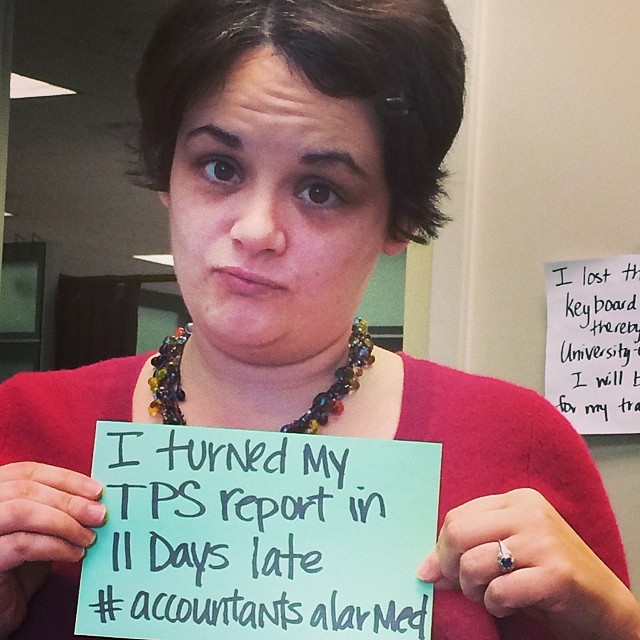 If you're not familiar with the film, Office Space, get thee to your Netflix list and order it up straightaway. Anyone who works in an office must see this movie because it not only provides catharsis for the modern worker (there's scene where the characters destroy an evil printer), it gives us perfect metaphors to describe what we don't like about our work. You see, I'm a fundraiser. I am focused on all things forward and outward. As a consequence, I am terrible at getting my expense reports done on time. Expense reports are important and I realize this but I cannot seem to get them done on time! This causes some problems for the accounting staff. The photo above is my "punishment" for one of the times that I turned my monthly expense report in 11 days late. I tried to look as remorseful as possible. We called the expense reports "TPS reports" because they had to be done in a certain, specific way and the fundraisers always seemed to be getting it wrong. So, even if it was done on time, you usually had to modify somehow to get it right after turning it in the first time. So, for your Friday fun and entertainment, I give you the Office Space scene RE: TPS Reports. Enjoy!  Chronicle of Philanthropy
The gold standard for philanthropy and fundraising jobs. I find it a bit frustrating that you have to select individual states in order to limit your search geographically but we can forgive that small frustration. If you are serious about growing your career, check this job bank regularly. (PS - I found out about my current position on this site.) Chronicle of Higher Education Pretty much the same as the Chronicle of Philanthropy, but specific to higher education. If you don't mind combing through or scrolling past lots of faculty positions, this is another great source. CASE Job Board The Council for the Advancement and Support of Education is the trade organization for higher education fundraisers, alumni relations, and communications/marketing folks. Their job bank is pretty good as most colleges and universities recognize it as a go-to place for higher education advancement professionals. AFP Job Board The Association of Fundraising Professionals website is super-clunky, but if you want to work for a smaller non-profit, arts organization or hospital, AFP's job bank is just the right place to search for that kind of a position. Higher Ed Jobs.com This site has done some significant upgrades since the last time I looked at it. They now have the capability to search by administrative area, which means you can restrict your search to just development and fundraising. There's also a nifty feature allowing you to search by region or metropolitan area. Nice! Individual Institutions pages Keep a short document with a list of institutions you would love to work for one day and copy their Human Resource job bank link into that document. Set a reminder in your calendar to check those at a regular interval (determined by your urgency to change jobs). Some institutions can't afford to advertise positions or feel that they are prestigious enough that they don't need to advertise. Keep tabs on what's happening at these institutions by checking at the source regularly. Head hunters Myers-McRae is the one I'm most familiar with, as I've been on search committees using this company to fill positions. It may take some searching but you want to find the one that is most popular for your preferred type of university and region. Myers-McRae tends to specialize at 4-year schools in the South. Google "higher education executive search firms" to begin your research process. A note: It is unlikely that this will be fruitful for you unless you have at least 5-10 of experience in a given area. Idealist.org This website is great for those that want to work for an organization that has an activist edge. A quick search and I found fundraising jobs at organizations that focused on women's rights, child welfare, climate change and disease prevention/cures. For profit serving not-for-profit You can develop a wealth of skills by working for a for-profit company that serves the not-for-profit industry. Companies like Blackbaud (Raiser's Edge database), Ruffalo Noel Levitz (phonathon and fundraising management), and Stelter (planned giving marketing) to name just a few are worth checking their career pages if you are looking to make a move. That's how I developed expertise in the area of phonathon by working with Ruffalo Noel Levitz (then RuffaloCODY) for five years. These organizations have established training systems and practice excellent benchmarking. There's no better way to learn best practices. 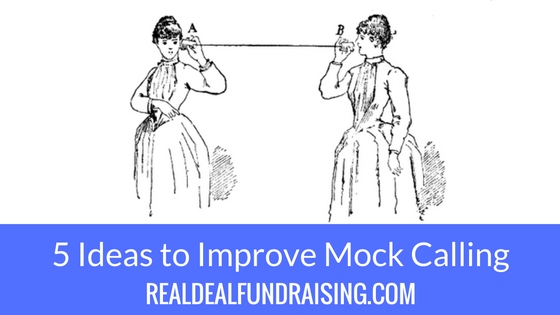 Mock Calling is a critical part of any new caller training session. It's also important for new major gift officers and leadership giving officers to practice in this same way. All-to-often, though, the exercise becomes stale and perfunctory. Here are 5 ideas to re-invigorate your mock calling practice, whether you work in phonathon, annual giving, or major gifts.
Voicemail Have your callers each call from their cell phones and leave a voicemail on your office line of an abbreviated script. Then have the entire training class listen to each voicemail and critique the caller based on enunciation, speed, sincerity and other qualities. Scenario Cards Create a set of cards with fake prospects on them. Create corresponding cards with background information on how the prospect is predisposed to react to an ask. Pair up callers and give them several sets of cards to work through alternating between caller and prospects. (This works for leadership and major gift officers too. Just practice asking for a visit and handling objections to taking the visit.) Observation Calls Have one caller go to a nearby office (far enough so they cannot see or hear the group) and have them call a line with a speaker phone function. Put the call on speaker phone so the rest of the class can hear the conversation. Make sure everyone gets a turn and that you debrief after every call what went well and what could be done better. Rapid Fire Objection Practice Divide callers into teams and have them stand in two rows. Give each caller at the front of the line an objection. “I can’t give this year. I just had a baby.” Caller must respond immediately. After each round, have an impartial judge (student supervisors or lead caller) award a point to the team whose caller handled that round best. Winning team gets a prize. Judge selects an MVP from both teams. (For full-time fundraising staff, just practice objections to taking the visit.) Power Intro Drills Practice just the first 10-15 of a call, including asking for the prospect, introducing the institution and yourself and lastly stating why you are calling. Every caller gets several chances and then everyone gets to go again at the end of practice. Select a most improved caller or two who show significant improvement. Judge their intros on sincerity, diction, energy and enthusiasm. Every fundraiser needs a strong introduction whether they are a student caller or the CEO. If you found this article helpful, you may also be interested in my e-book How to Staff Your Phonathon Super-Fast: Seven Secrets to Fill the Seats. It's on sale now for $40 with the coupon code fillseats (valid through 9/1/16). This book guides you through innovative ideas and practices to turbo-charge your phonathon staffing efforts and break free from the hamster wheel of turnover. It also includes an appendix full of templates and samples to get you started implementing this system fast. 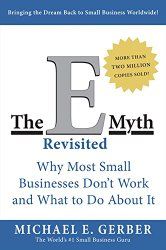
One of my first bosses introduced me to a little book called The E-Myth by Michael Gerber. I don’t even remember what the “e” stands for: Entrepreneurial, I think? But, what I do know is that it completely changed the way I thought about my work and I use the concepts in it every single day (more than 10 years later).
I was 23 years old and became the sole full time fundraiser for the 3rd largest political party in the country, The Libertarian National Committee. I had some staff to help me with gift processing and handful of interns but largely it was my show. I have no idea what made them think I was capable of this endeavor but I’m grateful for the myriad experiences that I got and the skills I couldn’t have otherwise developed. In particular, I was responsible for the management and cultivation of a monthly giving program that was the lifeblood of the organization. But, because it was really just me running the show, I think the Executive Director was a bit worried about the plan all being in my head. The classic question, “What if you got hit by a bus?” was one that he posed to me. He gave me the E-Myth to get me thinking about these issues. The E-Myth proposes that you shouldn’t always be working yourself out of a job. Yes, that’s right. You should document every routine task that you do so completely and thoroughly that you can delegate it to anyone and with minimal training they could execute the task in your place. I was hooked. Here was a way for me to empower my gift processors and interns to help me and reduce my daily stress and chaos. Process documentation is also the path to getting promoted. It is succession planning at its finest. It’s also just good management. You not only do the process documentation for your job but require that all of those who report to you do it as well. Now you have the basis for real accountability and knowledge of what everyone is doing at work. Today, process documentation is easier than ever to do efficiently and effectively. With screenshots and screen capture video software, you can train anyone to do routine computer button pushing tasks with complete accuracy. I highly recommend the E-Myth and encourage all organizations to begin the process of documenting their routine tasks. Creating an annual calendar of work with an accompanying training manual or video series seems dry and boring, but I assure you it changes the way you and all of those on your team approach the work. It is a productivity boost and an insurance policy all in one. If you're at least my age, you probably remember the old Gatorade commercial featuring Michael Jordan with the jingle "Like Mike, if I could be like Mike. I wanna be, I wanna be, I wanna be like Mike!" The theme was excellence and striving for near super-human ability.
Well, I'm not much of a sports person, but dance I understand. So, today, I present one of my favorite ballet numbers and ask you to "Be like Mikhail!" Mikhail Baryshnikov is one of the most outstanding dancers to ever perform. The choreography in this routine from Le Corsaire is so vibrantly energetic and obviously difficult but delivered so effortlessly that it takes your breath away. He soars across the stage. He's in control of each movement but so comfortable because of his practice and repetition that it appears spontaneous. Glorious! This number shows off Baryshnikov's excellence in all aspects: technique, performance, athleticism, musicality, and panache! Can you strive to be this confident, this excellent, this marvelous at your job? This is what you are spending your life doing, why not be great at it? Can you complete your role with such a high level of awesomeness that your inspire others to "wanna be" like you? Show your optimism and passion so obviously in your work quality that it is absolutely contagious! That's fun fundraising! Over the last few weeks, I've been posting about a wide variety of best practices to improve contact rates in phonathon. This post will serve to consolidate this information and recap the recommendations.
It is not possible to raise money from someone that you can't get in touch with, so contact rate is crucial to a healthy phonathon. When your contact rate improves, you will raise more money even if call quality doens't improve at all. It is not optional. You must have a plan to get your data clean and valid and keep it that way. First Steps to Improve Phonathon Contact Rates: This post outlines the importance of contact rates and details the basic research processes that every phonathon should be doing prior to loading data for the year. Next Steps to Improve Your Phonathon Contact Rate (Wireless ID and Wireless Append): This post lays out the trends with respect to households transitioning to wireless only. Your database must manage phone types properly to accommodate this shift. There are also new data research tools that you need to make use of to acquire cell phone numbers. Continuing to Improve Phonathon Contact Rates (Most Best Practices): In this installment, I recommend that you manage your data so that you do not load known invalid phone numbers for calling again. Once you remove those invalids, you'll need to find more groups to call and I show you how to lobby to call new colleges, schools or units. Improving Contact Rates in Phonathon with Where-Are-You-Now Emails: Besides making good use of data research services, you should also go to your constituents and ask them to update their information. In this post, I give an overview of sending next day "where-are-you" emails and "where-are-you" email blasts. Young Alumni, Contact Rates and the History of Cell Phones: This post shows why young alumni are a strong group for contact rate and gives a comprehensive argument for why you should not remove young alumni from phonathon. I hope you find these tips helpful. If you implement these strategies, your contact rate will improve. Improved contact rate in your phonathon will mean more money for your institution. Please comment below and let me know your results. This video tutorial shows you how to set up basic formulas in MS Excel. By using this method, you would be able find out your direct mail response rates and average gift. Also, I touch on how to "reverse engineer" your statistics if you only know the response rates and average gift, perhaps from a past mailer.
You can check out my other video tutorial on how to use Excel for fundraisers here. If you enjoyed this video please subscribe to Real Deal Fundraising. When I was working at Southern Miss, we received a file to do a mailer to parents of current students. Of course, Admissions didn't have lovely and clean addressee and salutation fields and in fact, we didn't even have the parent's first name in most cases.
I learned to use the "concatenate" formula to use that raw data to create addressees and salutations that were appropriate for direct mail. When we didn't have the parent's first name we used the student's name. It looked like "Dear Parents of John Doe,". Sometimes you make lemonade out of lemons. It's not uncommon in fundraising to get a list of prospects that has "raw data" with first name and last name as separate fields, no titles and no addressees or salutations. Before you can create a mail merge or import those into your database, you'll need to create the fields that you need. And you'll want to do it cleanly and efficiently. In this video, I'll show you 3 tricks in MS Excel that will help you save time and frustration in creating addressees and salutations for a list of prospects. 1) Use filters to create working groups 2) Use the "concatenate" formula to string text together 3) Use "paste values" to turn your data set into editable text If you liked this video, check out my video on using Excel's "filter by color" function to plan your donor trips. And subscribe to Real Deal Fundraising to get content like this in your inbox.  Hey you. Yes, you. Sitting at your work computer munching on your toasted bagel with cream cheese. And you there, scrolling on your phone on public transport. And you, scrolling on your laptop killing a bit of time before your staff meeting. I’m talking straight to you. All of you.
You are amazing. Really. Truly, amazing. You get up every day and do a job that most people would be scared out of their wits to do. You ask people for money and provide no tangible product in return. That’s hard work. And that work requires a broad-ranging and diverse skill set that many just do not have. The soft skills of messaging and etiquette and the hard skills of data and statistical analysis. You are also probably highly skilled at various aspect of technology too. It’s likely that to do your job you also have to have knowledge about finance, management, marketing and human resources. That’s a tall order. You are a force to be reckoned with. Your work enables students to get an education, hungry people to eat meals, animals to find homes and so many other wonderful life-affirming things. All of which wouldn’t happen without the work that you (and others like you) do. You are the superpower of the non-profit world, the engine that makes this sector move: the fundraiser. So, approach this week like the amazing being you are. At this point, you are probably sitting a little straighter, nodding your head in agreement at the realization of how awesome you are. Maybe you are claiming the amazing things your non-profit does in the world as your own accomplishments. Yes, they are yours. Own them. The more connected you are to mission, the happier you will be in your work and the more funds you will raise for your good cause. Now, ask yourself, how can I create this same feeling for each of my donors? What would make them feel amazing and personally responsible for the good things this organization does in the world? What would make them stand straighter and take ownership of the good your non-profit does? Do that and they will give more and they will feel amazing about giving, about your institution and about themselves. |

Jessica Cloud, CFREI've been called the Tasmanian Devil of fundraising and I'm here to talk shop with you. Archives
July 2020
Categories
All
|

 RSS Feed
